
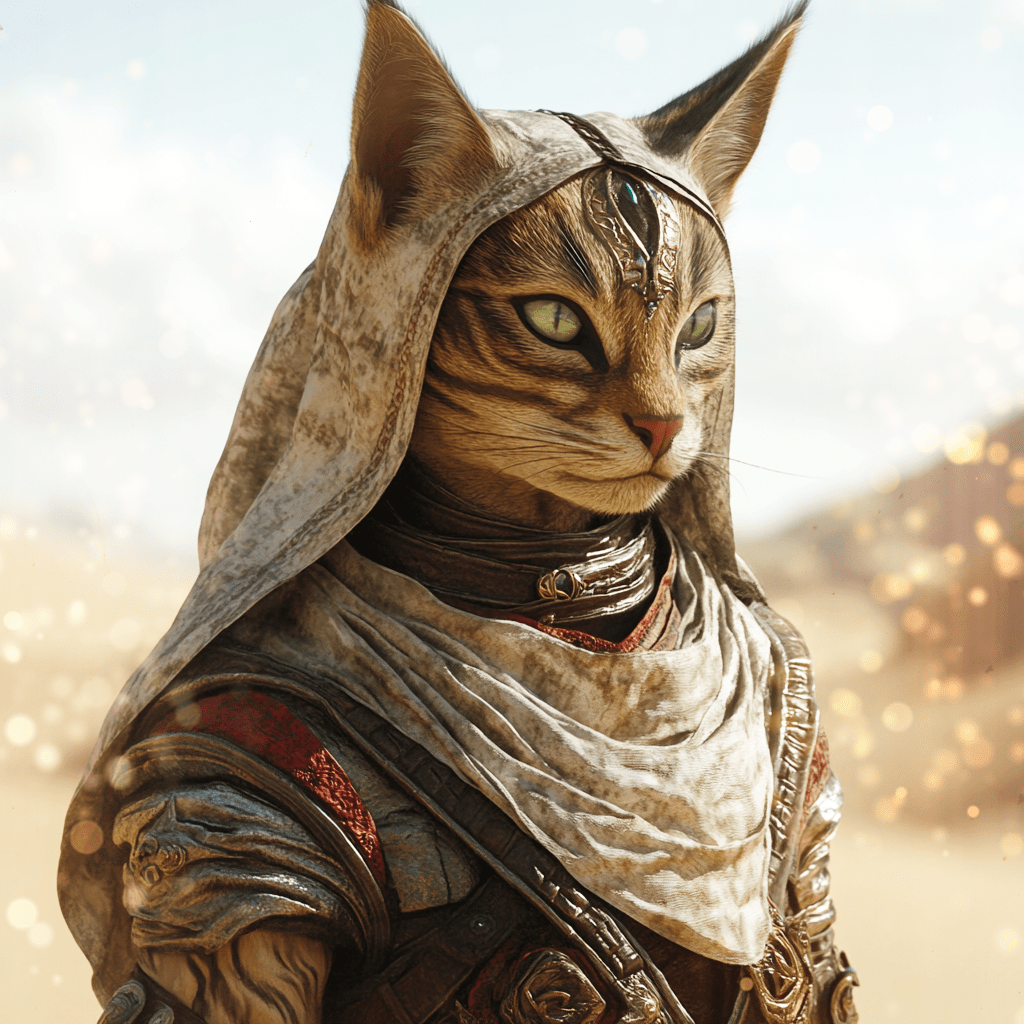
The Khajiit have always fascinated me. Their lore is steeped in this beautiful balance of mystery and darkness, divinity and danger. They aren’t just another beastfolk race in Tamriel—they are a culture deeply woven into the celestial fabric of the world, with beliefs that challenge the rigid lines drawn by other societies. And, let’s be honest, they’re effortlessly cool. Their legends don’t deal in absolutes of good and evil, but rather in the ebb and flow of cosmic forces, with Azurah guiding their steps and Namiira lurking in the shadows, always ready to claim those who stray.
The dual nature of light forces and dark forces is something I can relate to as a human. I think that we’re all tempted by one or the other at any given time, and perhaps that’s why the Khajiit are one of my favourite races in The Elder Scrolls.
Azurah: The Mother of the Khajiit
I love how the Khajiit don’t just see Azura as another Daedric Prince, but as their mother. According to their creation myths, she took Nirni’s children and shaped them into the many forms of Khajiit, tying them forever to the moons. To other cultures, Azura is a goddess of fate, but to the Khajiit, she’s far more personal—a guiding force that gives them their identity and their connection to Jone and Jode.
I think that’s what makes her so compelling. She’s not some aloof, untouchable deity; she actively shapes and cares for her people, even if her lessons come with a trickster’s smirk. She teaches the Khajiit to be clever, to adapt, and to embrace their unique nature. But, of course, where there is light, there is also shadow…
Namiira: The Hunger in the Shadows
Ah, Namiira. The ever-lurking darkness, the whisper in the void. If Azurah is the loving mother, Namiira is the thing under the bed, waiting for the moment you lose hope. She doesn’t just want to destroy; she wants to consume. The Khajiit fear her influence because they know that their connection to the moons makes them vulnerable to the dark forces of the Void.
The concept of the dro-m’Athra is one of my favourite aspects of Khajiit lore. These aren’t just “evil Khajiit.” They are those who have succumbed to the Bent Dance, twisting away from the harmony of the Lunar Lattice and into something… wrong. Imagine hearing a song you’ve known your whole life, but suddenly it’s just slightly off, slightly discordant, and the more you listen, the more you realise it’s pulling you in. That’s the Bent Dance. The idea that even the most devout Khajiit can be seduced by it is both terrifying and tragic.
And if you want a firsthand look at just how horrifying the dro-m’Athra can be, the Maw of Lorkhaj trial in ESO is a perfect example. Once a sacred temple, now a corrupted husk filled with the dark echoes of fallen Khajiit, it’s a cautionary tale come to life. Facing down the dro-m’Athra in battle, especially Vashai and S’kinrai, is a stark reminder that the struggle against Namiira is never-ending.
Here is a very short clip of me, a few years ago, finishing off both Vashai and S’kinrai on my own after my group all perished during the fight. It was… pretty hairy, to say the least.
The Hidden Moon, Lorkhaj, and His Tragic Fate
Lorkhan is a contentious figure across Tamriel, but in Khajiiti lore, he is Lorkhaj, the Lost Moon. And I absolutely love this interpretation. He was once a celestial force in balance with Jone and Jode, but he was betrayed, his heart cast into the Void, and he became the first dro-m’Athra.
This adds another layer to the idea of the Bent Dance—because if even Lorkhaj, the Third Moon, could fall, what hope does the average Khajiit have? It turns their struggle into something even more poignant, as they must constantly resist the pull of their own nature.
Other Daedric Influences on Khajiiti Culture
One of the things I love about Khajiiti lore is how they don’t paint the Daedra with the same brush as other cultures do. The Imperial perspective often places them in neat little boxes—good or evil, helpful or harmful—but the Khajiit? They see the Daedra as forces to be respected, bargained with, and, at times, feared.
Take Merrunz (Mehrunes Dagon), for example. The Khajiit don’t just see him as some mindless god of destruction. They acknowledge his fire as both a destroyer and a purifier. Some warrior clans even invoke his name before battle, treating him like a force of necessary chaos rather than a purely malevolent being.
Then there’s Boethra (Boethiah), a figure that fascinates me. The Khajiit consider her a warrior spirit who teaches them the values of rebellion and strength. She’s less of a dark deceiver and more of a harsh but fair teacher, which is an interesting contrast to how other cultures view her. There’s something deeply poetic about the way the Khajiit embrace struggle as an essential part of growth.
And let’s not forget Sheggorath (Sheogorath). Oh, how the Khajiit whisper his name with equal parts fear and amusement. Too much moon-sugar, and you might just hear him laughing in the wind. The idea that madness is just another part of the cosmic dance is such a Khajiiti way of seeing the world—it makes me appreciate their way of thinking even more.
Rajhin, The Trickster Thief-God
And then there’s Rajhin. Oh, how I adore Rajhin. If there’s a Daedric-adjacent figure that captures the absolute cheekiness of Khajiiti culture, it’s him. He’s the ultimate rogue, the thief of legend, the one who danced through Oblivion and lived to tell the tale (or at least, let others tell it for him).
His most famous heist? Stealing a Book of Fate from Hermaeus Mora. That’s right—he tricked the Prince of Forbidden Knowledge himself. If that doesn’t make you love him, I don’t know what will. His presence in Khajiiti myth shows that they don’t just revere power and wisdom; they revere cunning. And frankly, that’s just fantastic.
My Adventures with the Khajiit: Ember, Zerith-var, and the Trials of Elsweyr
One of the things that makes Khajiiti lore even more personal to me is the way it comes alive in The Elder Scrolls Online. I’ve spent far too many hours roaming Elsweyr, soaking up its stunning landscapes and fascinating people. And when I got the chance to adventure alongside Ember and Zerith-var, the Khajiiti companions in ESO, it felt like stepping even deeper into their world.
Ember is one of those characters who embodies the independent, streetwise side of Khajiiti culture. She’s clever, resourceful, and just the right amount of reckless—like a true Rajhin devotee. On the other hand, Zerith-var carries a darker, more introspective side. His past hints at a struggle between duty and personal demons, and honestly, that kind of moral complexity is what makes Khajiit such an incredible race. Their lives are dictated by cosmic forces, but their choices are their own.
And then there’s my old nemesis—the Maw of Lorkhaj. I progged this trial with a group for months back in the day, and let me tell you, nothing tests your patience (or sanity) quite like dodging shadowy horrors and trying not to get obliterated by Vashai and S’kinrai. But that’s exactly what makes it so fascinating—the story woven into the fight isn’t just about a corrupted temple; it’s about the ever-present danger of Namiira’s pull and what happens when Khajiit fall too far into the Bent Dance.
Not to mention it’s a gorgeous trial, probably one of my favourite for its lore and aesthetic and atmosphere, even to this day!
Why I Love Khajiit Lore
The more I dig into Khajiiti mythology, the more I realise why I love it so much. It’s not just about gods and Daedra—it’s about struggle. The eternal push and pull between light and shadow, between fate and choice. The Khajiit are tied to forces far greater than themselves, but rather than resign themselves to destiny, they fight to carve their own path.
The Bent Dance fascinates me because it’s not just a tale of corruption—it’s a warning wrapped in poetry. It’s the idea that even the strongest, even the wisest, can be led astray. And yet, the Khajiit continue. They resist. They thrive.
So, if you’ll excuse me, I think I’ll go wander Elsweyr, lose myself in its golden sands, and probably get distracted by a side quest or two along the way. That, after all, is the true Khajiiti way.
 Jenesque Gaming
Leave a comment